Tag Archives: book review

Book Review: Love Her or Lose Her by Tessa Bailey


Love Her or Lose Her (Hot & Hammered, #2)

Love Her or Lose Her by Tessa Bailey

Release date: January 14th, 2020

Genre: contemporary romance

Rating: 3 stars

Unfortunately, I didn’t enjoy this second installment in Bailey’s Hot and Hammered series quite as much as the first book, Fix Her Up, but it was still a fun, quick read that I think a lot of contemporary romance readers will likely enjoy. Love Her or Lose Her follows a married couple (unusual for a romance novel!), Rosie and Dominic, who, despite a deep love for one another that began when they were childhood sweethearts, find themselves at a point in their marriage where they’re only truly able to connect in the bedroom; otherwise, their communication has completely broken down. Rosie in particular has been feeling the strain, and kicks off the novel by leaving Dominic, as she’s feeling unappreciated and unsatisfied both professionally and in their relationship. The plot of the novel revolves around Rosie and Dominic’s attempts to reconnect through a hippie version of last-ditch couples counseling Rosie initially proposes as a challenge to Dominic, thinking there’s no way he’ll let his guard down enough to try therapy, and Rosie’s efforts to start her own restaurant, which she’s been dreaming about her entire life.  We also get to see glimpses of Georgie and Travis, the main characters from Fix Her Up, as well as what’s presumably the setup for the third book in the series, a meet-cute between Bethany and new-in-town, cowboy hat-wearing Wes.

On the positive side, this eARC really saved me when I found out that my flight had been delayed for 4 hours and was stuck at the airport, finding myself not quite in the right mood for any of the physical books I’d brought with me but looking for a fun contemporary romance. It’s a quick read, Rosie is a likable main character, and Bailey’s writing is snappy and funny. I continue to enjoy the girl-power aspect of this series that centers around the women in their community forming the “Just-Us League,” a group designed for female support and empowerment, and how Georgie, Rosie, and Bethany lean on each other and have each other’s backs.

On the negative side, I wasn’t so much a fan of Dominic, and I felt that there was a lot of his backstory that wasn’t explored thoroughly enough for me to root for him and Rosie as a couple. He was also very possessive, and there was a definite feeling of him reinforcing traditional gender roles in certain aspects of their relationship, which very much did not work for me. The actions of all the male characters in this book were often very unappealing; one scene in particular, when Rosie and her friends are planning a girls’ night out in the city, and their love interests are so insecure and upset by this that they follow them all the way to New York to exhibit possessive behavior and deny them a night out with their girlfriends, really rubbed me the wrong way. I’ll still definitely look to read more Tessa Bailey in the future, as I did enjoy Fix Her Up quite a bit, but overall I don’t think this was quite the right book for me.

I received an eARC of Love Her or Lose Her from NetGalley in exchange for an honest review.

Book Review: Get a Life, Chloe Brown by Talia Hibbert

Get a Life, Chloe Brown by Talia Hibbert

Genre: contemporary romance

Release date: November 5th

Rating: 3.5 stars

This contemporary romance, set in England, follows web designer Chloe Brown, a guarded woman dealing with her fibromyalgia diagnosis, and Redford Morgan, an artist-turned-property-manager, who’s dealing with insecurity and the aftermath of a traumatizing relationship. Our story kicks off when Chloe undergoes a near-death experience and decides that she needs to, well, get a life–to stop being afraid to make bold life decisions and go out and experience the world. She initiates this by moving out of her family’s house, but stalls trying to accomplish any of the next few tasks (ride a motorcycle, travel the world with minimal luggage, have meaningless sex, etc) until she meets Red, who she seems to think is the sort of “dangerous” guy who could help her with her list, but who in actuality is a complete sweetheart who happens to ride a motorcycle. While working through Chloe’s list, with some necessary modifications, the two confront their mistaken first impressions of each other (Red assumes Chloe is a rich snob, Chloe assumes Red is carefree and full of himself) and end up falling for each other.

There’s a lot to like about Chloe Brown, chief among them being the titular main character. Chloe is smart and fierce, but she’s also grappling with a lot of insecurities and still working on figuring herself out, especially in the context of the aftermath of her fibromyalgia diagnosis. She’s instantly likable, and scenes from her perspective are hilarious, full of surprising quips and witty observations; she’s a character I would happily spend more time with. I would also be completely on board with more books involving Chloe’s family, since her two awesome sisters and badass grandmother stole every scene they were in. I wasn’t as much of a fan of her love interest, Red, who wasn’t nearly as charismatic of a viewpoint character, and I felt that their romance, once it began, progressed much more quickly than felt natural. But there was another issue I had while reading this book, which I’m probably going to explain terribly, and which probably will be a reason many people love this one.

At risk of sounding like a terribly cynical person, I was taken aback by how considerately everyone treated each other in this book. Let me explain: Chloe Brown is ostensibly a hate-to-love romance, but the main characters never actually hate each other, and even if they make certain assumptions, they always treat each other with an abundance of consideration and respect. There are misunderstandings and disagreements, sure, but they’re all dealt with incredibly nicely. Which is fine! It’s fiction, it’s a romance novel, I totally understand that respect, consideration, and niceness are how we should all treat one another in life and in relationships. But for me, a lot of the time it did feel unrealistic, as people tend to be much more imperfect and messy when it comes to emotions, and although I can of course suspend disbelief when it comes to fiction and romance a lot of the time, I think I’d have preferred a messier story to a more perfect one. I think a lot of people might disagree with me on that, but I think it comes down to a matter of preferences in romance: I tend to like a little less ease and a little more angst, whereas Chloe Brown definitely falls into the “sweet” category, which was why, although I did overall enjoy the read, it didn’t get a higher rating from me.

I received an eARC of Get a Life, Chloe Brown from NetGalley in exchange for an honest review.

September Reading Wrap-Up

I had set a vaguely defined goal for myself for September (something like “read lots of books”) and I’m happy to report that I accomplished that. Not only did I finish more books than I have in the past few months, but I read several books that I rated over 4 stars, and I honestly enjoyed every single thing I read in September.

Let’s go to the stats and reviews:

Total books read: 9

ARCs: 2

Audiobooks: 2

#readmyowndamnbooks: 7

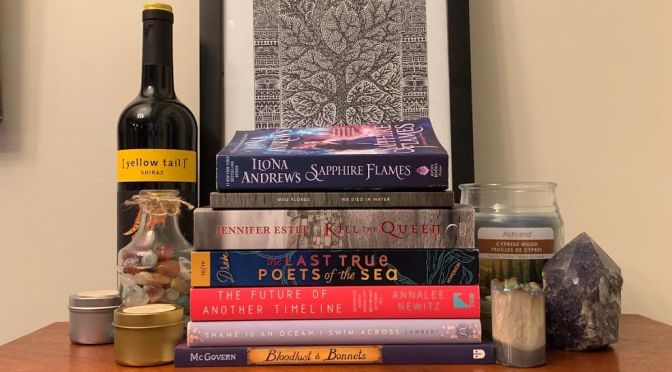
Sapphire Flames by Ilona AndrewsKill the Queen by Jennifer EstepThe Future of Another Timeline by Annalee NewitzShame Is an Ocean I Swim Across by Mary LambertParkland by Dave CullenWe Died in Water by Meg FloresBloodlust & Bonnets by Emily McGovernRadio Silence by Alice OsemanThe Last True Poets of the Sea by Julia Drake

Sapphire Flames by Ilona Andrews (4.5 stars) – Sapphire Flames is technically the fourth book in Andrews’ Hidden Legacy series, although it’s also technically the start of a new trilogy featuring the younger sister of books 1-3’s protagonist. I’ve actually just finished this one and LOVED it; I’m an Ilona Andrews superfan, but this was actually one of my favorites of hers. It’s set in a version of our world that features warring dynasties of magical families, and our main character Catalina has a very unique power; we follow her trying to solve a friend’s mother’s murder, protect her own family, and maybe connect with her crush, Alessandro, who has more than a few secrets up his sleeves. Honestly, this book is SO GOOD, and I think it’s also a great starting point for readers new to Ilona Andrews.

Shame is an Ocean I Swim Across by Mary Lambert (4.5 stars) – An impactful, striking, shiver-inducing autobiographical collection of poems that discuss sexual assault and its aftermath, falling in love, heartbreak, mental illness, and survival. There were several poems in this collection that made me pause, re-read, and take a moment to consider how Lambert used so few words to say so much. Her writing style is sometimes fluid and sometimes jarring; the poems are relatable and very readable but contain a lot of depth. I’d definitely recommend this one.

The Last True Poets of the Sea by Julia Drake (4.25 stars) – I absolutely loved this YA contemporary retelling of Twelfth Night that dealt skillfully with mental illness and sibling relationships; my full review will be up soon. I received an ARC at BookExpo from the publisher.

Radio Silence by Alice Oseman (4 stars) – really well done YA contemporary, revolving around two misfits and a science fiction podcast. I absolutely loved the main characters, and the writing and perspective felt extremely authentic. I did feel that the plot stumbled a bit towards the end, but overall I really loved this one.

The Future of Another Timeline by Annalee Newitz (4 stars) – Creative, feminist time-travel science fiction, set mainly in the 1990s and 1890s. Check out my full review here.

Parkland: Birth of a Movement by Dave Cullen (4 stars) – A very necessary and topical read. I listened to Dave Cullen’s Columbine on audiobook last month and was impressed by his research and thoroughness, and I wanted to pick up Parkland especially because it focuses almost exclusively on the March for Our Lives kids and movement rather than the school shooting itself; although the books are related, they emphasize very different things. The Parkland kids are so impressive and inspirational, and I think Cullen did a great job capturing what they are trying to accomplish.

Bloodlust and Bonnets by Emily McGovern (4 stars) – the first graphic novel I’ve picked up in literally years, because it’s by the author of a webcomic I adore (My Life as a Background Slytherin). It’s a parody of historical/Regency romances, with an added fantastical element, and I quite enjoyed it. We follow Lucy, our heroine, who feels like a misfit under the constraints of proper society; Lord Byron (“from books!”), a poet with a very short attention span and a penchant for stabbing any vampire he sees; and Sham, a mysterious vampire hunter, on their adventures around England while trying to infiltrate a secret vampire society but keep getting sidetracked. I found it very cute, quirky, and funny, although for me it maybe wasn’t quite as consistently hilarious as McGovern’s webcomic tends to be, likely because there’s a lot more plot in a graphic novel than a 1-page webcomic. The art style and colors are likewise adorable and fun, and I’m definitely glad I picked it up.

We Died in Water by Meg Flores (4 stars) – We Died in Water is a memoir told in short prose poems that focuses on themes of love and leaving, using the ocean to help tell the author’s story in a variety of metaphors. The memoir itself mirrors the waves in structure, by repetition of the stories of loving and heartbreak that both the author and her mother experienced, stories that echo each other and force both the author and the reader to wonder if we are doomed to repeat our families’ pasts. As someone who’s always loved the ocean (as you can probably garner from my account name), I loved the integration of waves and ocean imagery into the author’s retelling of her story, and I found the writing overall to be lovely and fluid, while still retaining clarity, which can be difficult in a book with a nontraditional structure. It’s a beautiful, thoughtful little book, and I’d recommend it if you enjoy unconventional structures, poetry, and the ocean.

I received an early copy of We Died in Water from the author in exchange for an honest review.

Kill the Queen by Jennifer Estep (3.75 stars) – Mistakenly thought this was UF when I picked it up (the leather pants threw me off!) but it’s actually a really fun, fast-paced royal revenge plot in a full fantasy world with a writing style that reminds me of UF. I really enjoyed it–our main character Everleigh, a minor royal, survives an assassination attempt on the royal family, and joins a gladiator troupe, where survival turns into a desire for vengeance. She has to use the magic she’s kept hidden her entire life as well as every ounce of the cold rage that fuels her in order to do what she’s never even imagined–try to kill the queen. It’s got action, humor, and the hint of a romance, plus literally every character is wearing black leggings at all times, which is a fantasy world I can really get behind. There’s also a really interesting magic system featuring everything from enhanced senses, shapeshifting, and elemental magic. I’m about to start the second book, Protect the Prince, and I’m really interested to see where the story goes from here.


Have you read any of these, or are any of them on your TBR? Let me know in the comments!
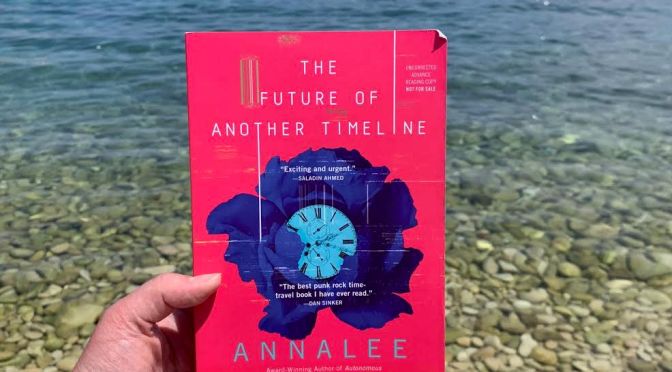
Book Review: The Future of Another Timeline by Annalee Newitz

The Future of Another Timeline by Annalee Newitz

Genre: science fiction

Rating: 4 stars

I have mixed feelings about time travel-focused science fiction; it’s never an element that draws me toward a story, but I’ve found it to be an interesting plot device in the hands of the right author (prior to picking up this book, namely Connie Willis, whose writing style I love). One of the things that can make or break a time travel plot is the method of time travel presented, and this was an element that I really enjoyed in The Future of Another Timeline: time travel is geology-based, and centers around specific rock formations in several locations around the world. We’re never sure whether the rock formations are a natural occurrence or whether they’re a remnant of a past advanced or alien civilization, but we know that one travels through time by tapping out specific patterns into the rock, and that humanity has barely scratched the surface of what the machines are truly capable of, and that explanation/non-explanation worked for me, because it felt unique, somewhat organic, and added a persistent oddness and potential for twists in the story.

The Future of Another Timeline follows time-traveling geologist Tess, who is ostensibly a researcher focusing on the late 1800s but in actuality is part of a secret organization dedicated to fighting for women’s and non-binary persons’ rights and preserving their contributions to society by manipulating the timeline and fighting against a shadow organization attempting to suppress women and non-binary persons in the past so that they can create a male-dominated future. We’re also following Beth, a teenager in the 1990s in California who is enmeshed in riot grrl culture and who’s dealing with a complex and precarious family situation, as well as the fact that she and her friends have just killed a rapist. We bounce back and forth between these two storylines throughout the book, with a few interludes from other perspectives, as Tess and her organization strategize about how to save the future while Beth deals with both emotional fallout and rising danger.

I found the writing style of Timeline to be concise, clear, and quick-moving; Newitz’s background as a science journalist feels clear in the story’s telling. It’s a fascinating premise, and one that could be intimidatingly complex if not told as succinctly as it was. The emotional depth of the story, however, was more inconsistent; I felt much more connected to Beth’s story than Tess’s, and not just because one involved time travel and one didn’t, but because Beth felt like a more fully realized character, whereas I never truly felt like I had a handle on who Tess was, beyond her fight for societal justice.

Beth’s portion of the plot, as well, was more gripping for me, probably because it was much more personal and immediate; it was as though, strangely, even though this is a book about time travel, it may have been a stronger story without the time travel element altogether, and just focusing solely on Beth. Newitz creates a fully realized vision of 1990s California, rife with punk rock, hypocrisy, the allure of freedom, and the crushing weight of restrictions placed on teenagers that prevent them from fully realizing that freedom as it lurks just out of reach with the escape of college. There were parts of Tess’s story that did work for me as well, particularly the parts featuring the other members of her society, the Daughters of Harriet (named for Harriet Tubman, who became a senator in this version of history), but for me the parts set in the 1890s tended to drag and felt oddly paced.

If you enjoy fast-paced, well-written science fiction that focuses on politically relevant issues, I do think you’ll enjoy this one. The Future of Another Timeline comes out tomorrow, September 24th.


Thank you so much to the publisher for the opportunity to pick up an ARC of The Future of Another Timeline at BookExpo.

Book Review: Wilder Girls by Rory Power

Wilder Girls

Wilder Girls by Rory Power (release date 7/9/19)

Genre: YA weird fiction

Rating: 4 stars

A lot of people have been calling Wilder Girls a female version of Lord of the Flies; I’d say it’s much more of a YA take on Jeff Vandermeer’s Annihilation, since both involve an all-female cast, weird fiction focused on a very specific environment, and an overlying sense of unease and strangeness. Unlike Vandermeer’s creation of humid Florida otherness, Wilder Girls is set on an isolated island off the coast of Maine, home to an all-girls boarding school that has been completely cut off from the mainland for a year and a half after the outbreak of a mysterious disease referred to as the Tox. The Tox, along with causing intermittent episodes of crippling pain and affliction, warps the bodies of the girls to suit its opaque purposes: one character’s hair glows, and the cover illustration shows a metaphorical look at the potential for beauty in these mutations, but the reality for the rest of the girls is much more sinister: our main character Hetty’s eye has been sealed shut, her best friend Byatt has grown a second, alien spine, and our hair-glowing friend Rae can’t use one of her hands.

The disease and quarantine, however, are affecting more than just the girls’ bodies. The majority of their teachers are dead, and no other adults are left alive on the island; the Navy sends food intermittently, but it’s never enough; and the girls are forced to be constantly vigilant against the threat of attack from Tox-warped wild animals from the surrounding forest. Contact with the outside world is almost non-existent, but the girls still left alive have become survivors, adapting to an unthinkable new reality with pragmatism and strict adherence to the new rules of their lives. Until a few crucial things change: Hetty acquires new information that makes her question what’s really happening on the island, and her best friend, seemingly irrepressible, blue-blooded, capricious Byatt, goes missing.

I love weird fiction (think Vandermeer or Samanta Schweblin) and am delighted to find the genre finding a foothold in YA. Powers creates an intensely atmospheric setting in Raxter Island that feels like a character itself, and the mysterious illness plaguing the island’s inhabitants is a constantly creeping antagonist, at times forced to the background and at other times reasserting its presence forcefully, throughout the other horrors that the characters encounter. Hetty is a tough, survival-focused main character, and I loved her loyalty to her friends, her determination, and her slowly developing romance with Rae. I also loved complex, morally grey Byatt, who I could easily read another entire book about.

Wilder Girls is fascinating and immersive, and I didn’t see a lot of the plot twists coming, but the pacing is a bit irregular and unconventional, which may bother some readers, although it wasn’t an issue for me personally. And I’m not going to give away any spoilers, but I do need to address the ending. I really don’t mind an open-ended or thought-provoking ending as long as it’s done well–Kelly Link is one of my favorite authors, for example, and all of her stories both end and begin ambiguously. But I didn’t feel that this was the case in Wilder Girls, and rather than feeling ambiguous, the ending struck me as unfinished, and unfortunately didn’t work for me, which is why I’m giving this 4 stars rather than 5.

Thank you to NetGalley and the publisher for the opportunity to read an eARC of Wilder Girls in exchange for an honest review.


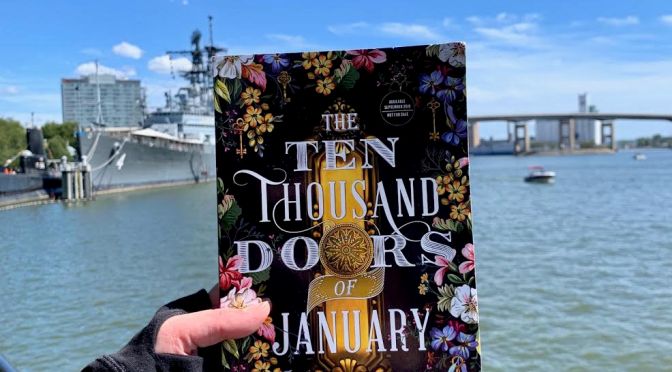
Book Review: The Ten Thousand Doors of January by Alix E. Harrow

The Ten Thousand Doors of January by Alix E. Harrow – 3 stars

Release date 9/10/19

Standalone historical fantasy

The Ten Thousand Doors of January had an intriguing premise and was solidly written, but unfortunately missed the mark for me. I do, however, think it’s a book that a lot of readers will love, particularly readers of historical fiction looking to dip a toe into the fantasy genre, or YA readers looking for an approachable crossover adult fantasy.

Ten Thousand Doors follows January Scaller, the ward of a wealthy New England businessman, Mr. Locke, whose father traverses the globe searching for other cultures’ treasures for Locke’s Archaeological Society to make their own. January is mixed race and has a hard time determining her place in the world; she lives in a sprawling mansion, but isn’t wealthy herself; she’s curious and intelligent, but her options as a woman in the early 1900s are limited;  and she’s often treated with confusion about her background or outright prejudice when she’s not under the eyes of the influential Mr. Locke. January’s worldview undergoes a dramatic shift when she discovers the existence of magical doors that can lead from our world to others, and later a mysterious book that elucidates some of the secrets of the doors, as well as some of the mysteries of her own past.

I loved the concept behind Ten Thousand Doors; portal fantasy is a subgenre I’ve been obsessed with from a very young age, and some of my absolute favorite books are portal fantasies (In Other Lands by Sarah Rees Brennan; The Magicians by Lev Grossman; Seanan McGuire’s Wayward Children series, etc). I was intrigued by the prospect of thousands of such doors and the different worlds to be encountered behind them, and I loved the discussion throughout the book about how the doors are bringers of change and societal upheaval, as they introduce new concepts and ideas into stagnant worlds. I loved as well how a certain door-related magic manifests later in the book (I don’t want to go into any more specifics to avoid spoilers). What I didn’t love was that we really didn’t get to see many of these worlds; we’re really only given glimpses into a few of them, and the most interesting one of those is only discussed secondhand, for a short period of time (albeit by an extremely badass side character, who I wish was the central character in this story). Ten Thousand Doors feels very much like a historical fiction book with just a hint of fantasy, and while that might appeal more to some readers, it wasn’t necessarily for me; I wanted more portal fantasy and less early 1900s.

I also overall wished for more character development and consistency over the course of the book. There were times when I really liked January and found her genuinely interesting and admirable, but I found her characterization to be uneven, and none of the side characters, allies or enemies, felt fleshed out enough to give the story emotional weight. Ten Thousand Doors has several characters who, on the surface, should be fascinating–a life-sucking vampiric being, a warrior-woman, travelers who hop from world to world–but as a reader, I never really got to connect enough with any of them since they were all filtered so heavily from January’s limited perspective on the situation. I also had a lot of difficulty due to the predictability of the plot; most of the twists were very much foreseeable, and one that wasn’t lacked the emotional weight I wished it had. The story is told from two perspectives and includes excerpts from the mysterious book that January finds, and at first I really liked the changing narratives and slow reveals, but since I was able to see what direction the plot was heading in fairly early on, this worked less and less for me as the book went on.

Although this wasn’t the book for me, I do think it’s a story that many readers will connect with and love. I received an ARC of The Ten Thousand Doors of January from the publisher at BookExpo.

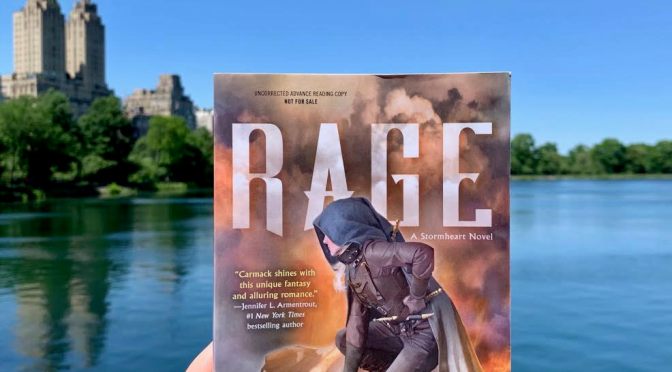
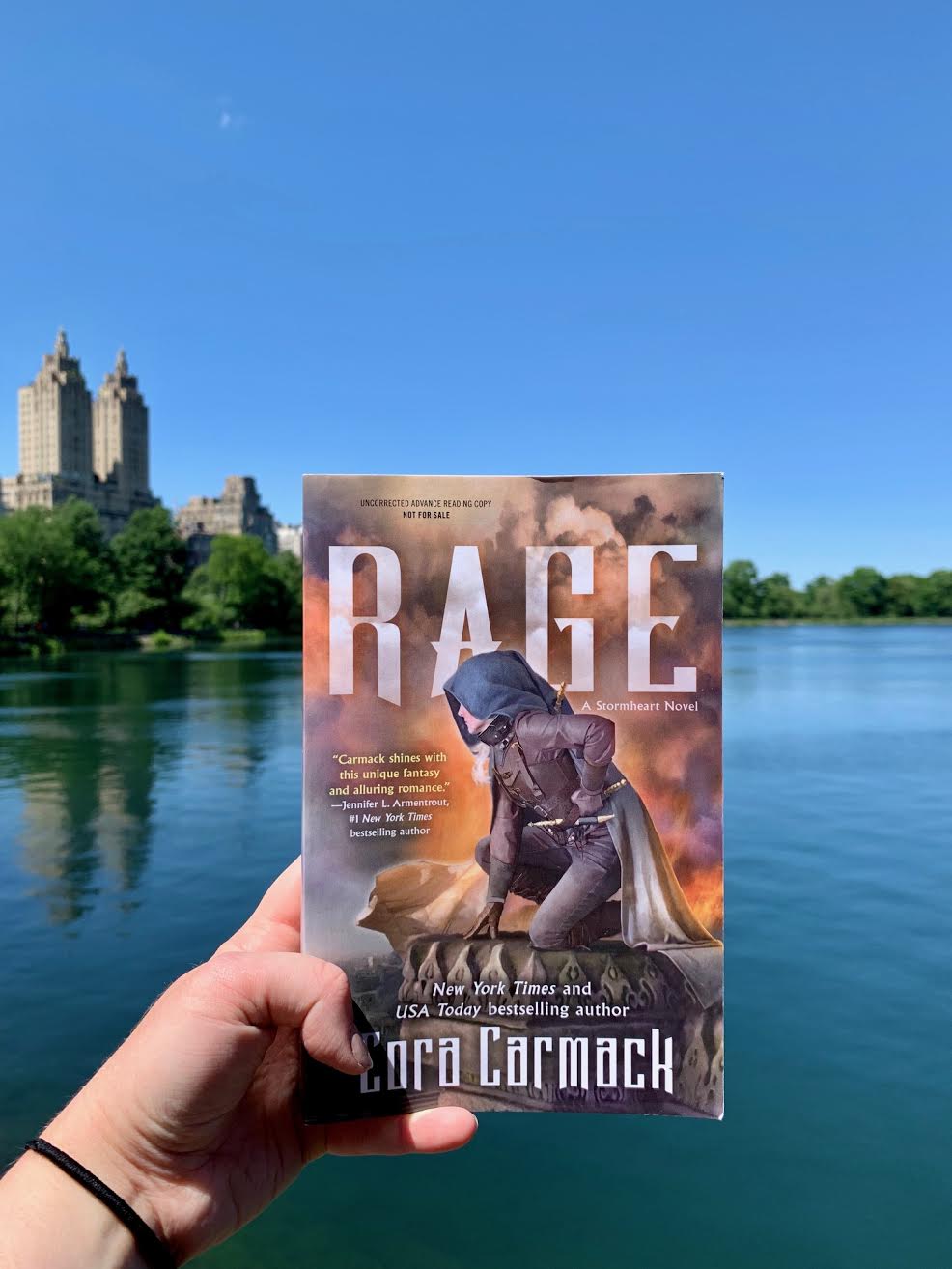
Book Review: Rage by Cora Carmack

Rage by Cora Carmack (release date 8/27/19) – 4 stars

Genre: YA fantasy, 2nd book in the Stormheart series

I read a lot of fantasy, but I have certain draws and preferences within the genre; not all magic systems work for me and hold my interest equally. Weather magic, however, almost always does, which was why I was initially drawn to the Stormheart series by Cora Carmack. In 2017, my first year attending BookCon, Tor was selling finished copies of Roar, the first book in the series, ahead of publication and for a discount, and between the gorgeous cover featuring a stormy sky and a Danaerys Targaryen-looking main character, I was instantly drawn in. Roar ended up being the first book I picked up after BookCon, and I fell in love with Aurora, an unsure young heroine who doesn’t quite fit the role of princess and weather magic wielder that she was born into, as well as the harsh, unforgiving, storm-ridden land she inhabits. (I’m going to try to review Rage without spoilers for either Rage or Roar, since I think this series deserves a lot more attention than it’s been getting, and I don’t want to deter any new readers by spoiling the plot of the first book.)

In Roar, Aurora flees her country after learning of her impending engagement to Cassius Locke, a prince she doesn’t trust, and after being belittled and forced to hide her true self for many years due to her terrible secret: although a princess and daughter of a powerful storm magic-wielder, Aurora herself has no power, which, if she were to take the throne without a partner, would leave her kingdom defenseless to the storms that regularly ravage the land. This is especially true due to the emergence of the Stormlord, a malicious storm magic-user who is able to call storms to do his bidding, not merely battle them as storm magicians tend to. Aurora falls in with a band of Stormhunters, who seek to harvest magic from the heart of storms in the wild country, at great personal risk, and the journey she takes forces her to question her beliefs about both the nature of storm magic and her own power.


When we pick back up with Aurora and her band of Stormhunters in Rage, a lot has changed. Aurora has gone through a lot of personal growth, which is ongoing in Rage, and provides a constant theme: Aurora isn’t perfect, but she’s trying, and she’s learning, and she genuinely wants what’s best for her friends and for her people. She also finds out what’s been going on in her home country of Pavan during her absence, which is more dire than she had realized; there’s a refugee crisis storyline that’s extremely politically relevant. We also learn a great deal more about the mysterious Stormlord and his motivations, which made me much more interested in him as an antagonist, and we get to hear more from side characters as the story jumps from perspective to perspective with less constant focus on Aurora compared to the first book, while still centering her personal growth in the narrative.  The multiple perspectives make the book flow quickly and retain tension throughout; I was never bored with the narrative but rather constantly looking for the next chapter in each character’s story.

The Stormheart series has a strong romantic component, and although I love the series overall, I’ve never actually been a fan of its central romance between Aurora and one of the Stormhunters she meets. I am, however, very much a fan of a burgeoning romance between two female side characters that’s set up in Rage, as well as the possibility that Aurora and Cassius Locke may be drawn together as the series goes on; I’m a sucker for the arranged marriage-turned-enemies-turned-something-more? dynamic that they have going, even though the characters haven’t spent much time together on the page.

In my opinion, the Stormheart series is a fun, weather-magic-fueled, romantic YA fantasy series that doesn’t get nearly enough hype considering what a fun read it is. I’d recommend jumping in if you enjoy your YA with a through-line of empowerment and growth, lovable characters, and a unique magic system.

I received an ARC of Rage from Tor Teen at BookExpo in exchange for an honest review

Book Review: Gideon the Ninth (AKA My Favorite Book of 2019 So Far!)

Gideon the Ninth by Tamsyn Muir (5 stars)

I’d like to start this by saying that Gideon the Ninth is, without question, my absolute favorite book of the year so far, and I did not at all expect it to be. Sure, I’d been hearing a lot of hype and seeing plenty of 5-star reviews leading up to BookExpo, and the premise sounded intriguing (it’s frequently pitched as “lesbian necromancers in space!”), but I’ve been burned by hype before, and I tend to go into most popular new releases with cautious optimism rather than sky-high expectations as a result. And then, less than 100 pages into Gideon the Ninth, I realized that my cautious optimism had turned into full-blown joy at how much I was absolutely loving  this book, and that I was reading something really special.

We’re thrown into the bleak, empty, skeleton-filled world of the Ninth House, where Gideon Nav, a sword-obsessed indentured servant, schemes and dreams of escape. An opportunity arises in the form of a magical competition of sorts between the nine Houses of the realm, where Gideon will need to form a tenuous alliance with her greatest enemy, Harrowhawk, the Reverend Daughter (princess/cult leader) of the Ninth, in order to survive. I don’t want to give away any more of the plot than that; I honestly feel that going in with very little plot knowledge is ideal, since Gideon the Ninth is full of twists, but I will tell you that the plot that we’re thrown into contains an abundance of dark humor, necromancy, alliances, betrayals, murder, scheming magical Houses, escape room-esque magic tasks, sword fights, and sarcasm.

It’s hard to express just how happy reading Gideon the Ninth made me feel. There’s this absolutely wonderful feeling you get when you’re completely obsessed with a world that you’ve only just met a few hundred pages ago, and it’s almost shocking how quickly you’ve been immersed, and you desperately want to keep reading because it’s so awesome, but you also want to slow down so that the book won’t end. That’s how it feels to read this book.

Tamsyn Muir imbues this story with so many completely intriguing concepts; the magical and political systems are intricate and yet we, as newcomers to this world, are able to become enmeshed in them alongside Gideon, whose isolation in the Ninth have kept her both literally and figuratively in the dark. And then there’s the characters, every one of whom I wished for more time with, because they’re all flawed, complicated people practicing dangerous magic and/or deadly swordsmanship, and because their interactions with each other illustrate the cultural differences between each House.

In summary: read this book. It comes out on September 10th, it’s the first book in a trilogy whose second book I literally cannot wait to read, and it’s something special.


Thank you so much to Tor for the opportunity to read and review an ARC of Gideon the Ninth.

Book Review: The Right Swipe by Alisha Rai

The Right Swipe by Alisha Rai: 4 stars!

Alisha Rai quickly became one of my favorite contemporary romance authors when I binge-read her Forbidden Hearts trilogy last year, because her books are full of all the chemistry you could possibly want in a romance novel, with the added bonus of fantastic side characters, complex family dynamics, and strong female friendships. When I heard that she was developing a new series called Modern Love, I knew I’d need to pick it up immediately; my only hesitation about reading The Right Swipe was that it focused on a former professional athlete, which is not exactly a favorite romance trope of mine.

The Right Swipe follows intelligent, ambitious dating app creator Rhiannon Hunter, who we actually met as a side character in the Forbidden Hearts trilogy (but don’t worry, you don’t have to go back and read those in order to enjoy this book–although I highly recommend them) and who is laser-focused on helping her company Crush not only succeed but expand and thrive. In her quest to purchase an older dating site in order to expand Crush’s reach, she runs into a one-night stand who committed the cardinal dating sin of ghosting her after an amazing night a few years prior. Meanwhile, her past hookup Samson Lima, a former pro football player who spontaneously retired in the middle of a game to protest the lack of concussion safety regulations, hasn’t been able to stop thinking about her–and actually had legitimate reasons for ghosting. But Rhiannon doesn’t know that, and when she finds out that Samson has signed on to do a marketing campaign for the company she’s trying to acquire, she wants nothing to do with him…until she does.

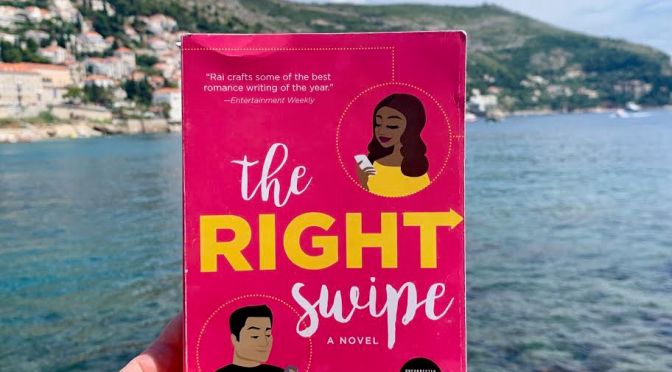
For me, The Right Swipe was everything I wanted in a summer read. I brought it with me on vacation (the picture above is from Croatia!), and it kept me hooked throughout a 6-hour delayed flight ordeal, which in my opinion is a true test of the quality of a book. Alisha Rai’s writing is smart and addicting, and you grow to love her characters instantly. Like in her previous trilogy, the side characters stood out just as much as the main couple: in particular, I can’t wait to read more about Katrina, Rhiannon’s best friend and sometime roommate, who is a former model dealing with trauma from a past relationship manifesting in severe social anxiety, and Lakshmi, Rhiannon’s supremely competent and confident assistant. But I grew to love both Rhiannon and Samson, who complemented each other in all the right ways: where Rhiannon is more cerebral and business-savvy, Samson is quieter and more in touch with his emotions, and their dynamic worked really well. A lot of summaries I’ve read of The Right Swipe seem to imply that Rhiannon and Samson have a competitive business rivalry going on, but that’s actually not the case, which I was relieved about; they quickly begin to work as a team rather than rivals.

If you look for not only fun banter and chemistry but a healthy relationship dynamic in your romance reads, The Right Swipe has got you covered. And if you’re a fan of smart contemporary romance that features a badass female main character, you’re really going to need to pick this one up, and then start waiting impatiently for the next book in the series (fingers crossed that it focuses on Katrina or Lakshmi!).

Thank you so much to Goodreads and Avon for the opportunity to read an ARC of The Right Swipe!

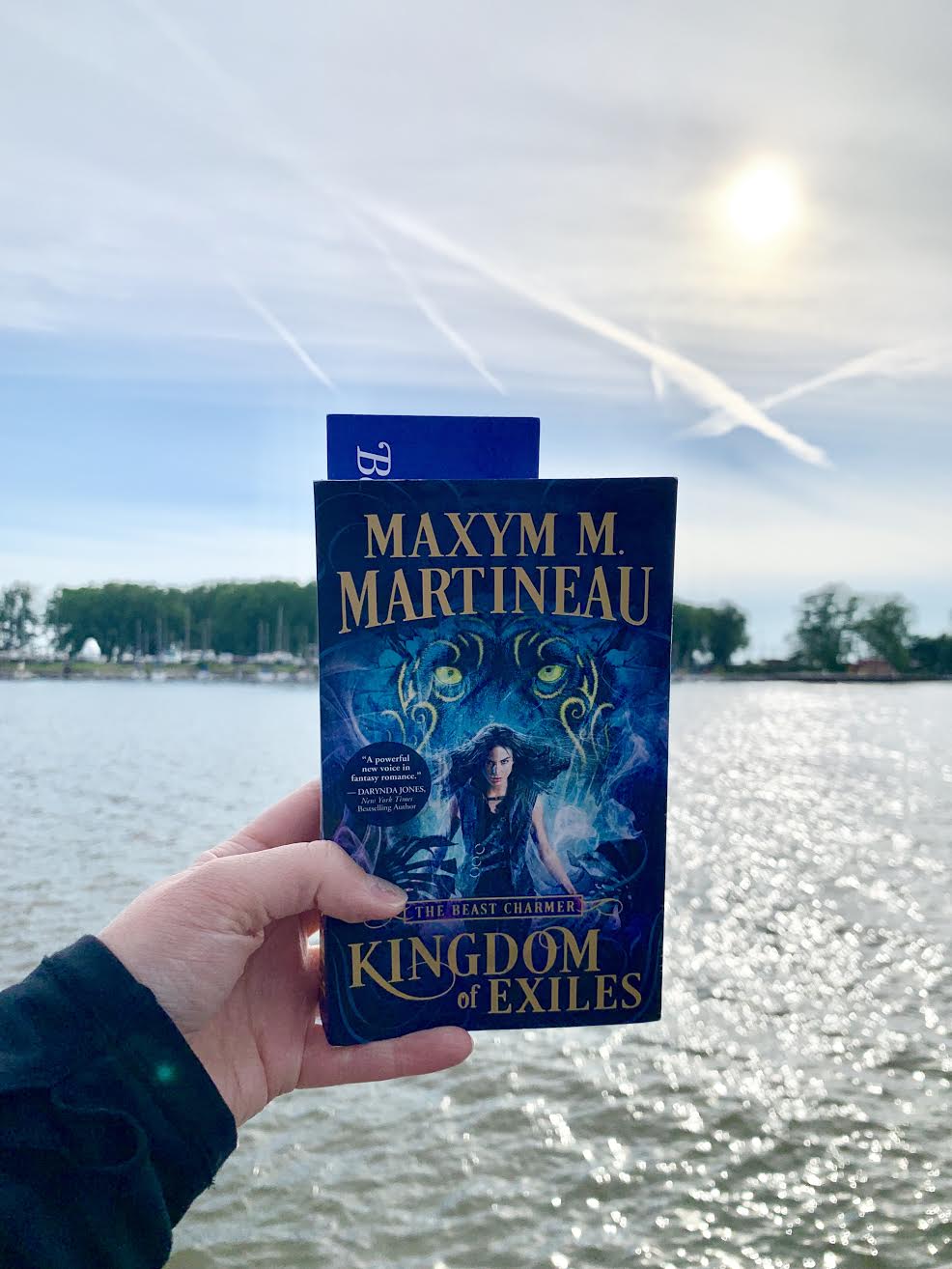
Book Review: Kingdom of Exiles by Maxym M. Martineau

Pokemon-like creatures and undead assassins, with a healthy dose of romance. If any of that sounds appealing to you, I’d recommend Kingdom of Exiles as a very fun fantasy read.

Kingdom of Exiles follows Leena, the titular exile, who’s been thrown out of her home city for a crime she didn’t commit and forced to do things she finds abominable in order to survive. Leena is a Charmer, who, not unlike a Pokemon trainer, has the ability to find and catch magical beasts, whose powers aid her and whose companionship she loves. She wants to clear her name and return to her mystical home of Hireath, where Charmers and their creatures exist in a seeming utopia, but first she has to capture a creature capable of proving her worth. Enter Nox, whose guild of assassins has been hired to take Leena out, but who finds her intriguing and useful enough to strike a bargain: his assassins won’t kill her if she’ll find useful magical creatures for them. This kicks off a journey through gorgeously imagined settings, featuring a number of wonderful-sounding magical creatures, a healthy dose of banter, strong friendships, and plenty of action.

Fantasy worldbuilding, and placing your reader directly inside scenes that may be taking place in, say, an evil and magical forest, or a city inhabited by magical beasts and their Charmers, can be really difficult, but I think that’s something Kingdom of Exiles really excels at. As a character-focused reader, sometimes I’ll find myself having to force myself to re-read descriptions of scenery in books to try to imagine where exactly these characters are spending their time, and sometimes it can be a struggle. I never felt that way during this book, even though its setting is wholly unique. The variety of magical creatures in this book is another huge strength; every time we were introduced to a new one, I was fascinated by their uniquely imagined abilities, and the powers and world of the Charmers was a great concept.

What I liked less about this book was, unfortunately, the romance. I liked both Leena and Noc quite a bit, and I very much like the idea of them together, but I did feel that the chemistry was a bit lacking for me. I also found myself struggling with certain plot points towards the end of the story, which felt rushed and/or jarred slightly with the pacing that had been established earlier in the book.

Overall, I found this to be a very enjoyable fantasy read, and I’m quite interested to hear more about what happens to Noc, Leena, and friends in the second book. I’m also very much hoping for even more magical creatures. 3.75 stars.

Thank you so much to NetGalley and Sourcebooks Casa for the opportunity to read an eARC of Kingdom of Exiles in exchange for an honest review.